Tell us about the job
Takes about a minute. No obligation.
A contractor diagnosing a heat pump repair in Radford city starts with the system's service record and the condition of its components, because those are what break things here. 34 severe weather events were recorded in Radford city, Virginia between 2015 and 2024. At that rate, severe weather touches equipment in this area periodically, but a failing compressor or a worn reversing valve is far more likely to trace back to years of deferred maintenance or the original install quality than to storm exposure. A contractor will check refrigerant charge, electrical connections, and the condition of moving parts before weather ever enters the conversation.
Stock built before the energy crises of the following decade was designed around different heating assumptions, and whatever heat pump sits in a Radford home today was retrofitted into that context at some later point. Half the homes in Radford city, Virginia were built in 1976 or earlier (2020-2024 ACS 5-year). A contractor opening a system in housing of this vintage finds wear that is specific to how long and hard that particular unit has run, not a condition shared across the model line. Contactor pitting, refrigerant circuit degradation, and coil fouling each tell a different story, and the parts a system that old requires are not always still in production. That parts availability question shapes the repair scope before the contractor closes anything up.
The Parts of a Heat Pump a Contractor Checks First
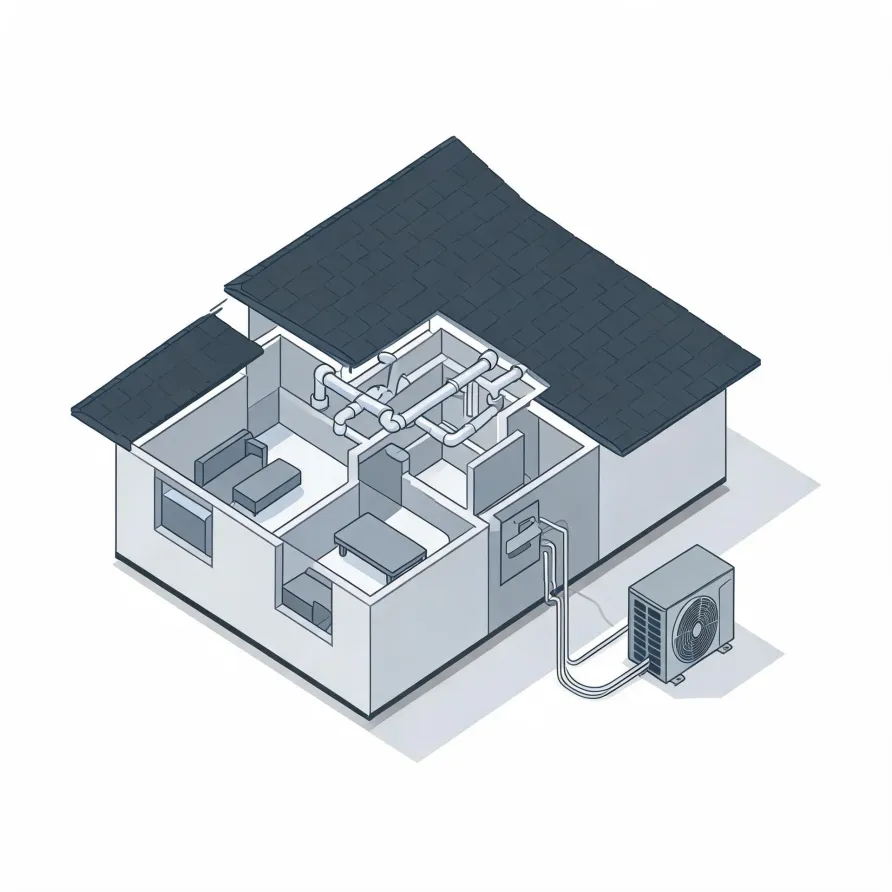
The outdoor unit sits on a pad beside the house and holds the compressor and the condenser coil. The compressor is the heart of the system, and when it fails, the heat pump stops moving heat in either direction. The condenser coil and the fan that draws air across it are also common places a contractor looks when the system runs but does not perform.
The air handler lives inside, usually in a utility closet, attic, or basement, and it pushes conditioned air through the home. It contains a blower motor and an evaporator coil, both of which can cause problems with airflow, temperature, or the ice buildup that sometimes signals a refrigerant issue. The reversing valve, which sits inside the outdoor unit, controls which direction the system runs, and a failed valve is often why a heat pump heats but will not cool, or the reverse.
The drawing shows a general layout of these components, and a licensed contractor determines which parts need attention in your specific home.
Get matched in Radford cityRadford City, Virginia, by the numbers
34 severe weather events were recorded in Radford city, Virginia between 2015 and 2024.
NOAA National Centers for Environmental Information, Storm Events Database, bulk CSV export, events 2015-01-01 through 2024-12-31.Half the homes in Radford city, Virginia were built in 1976 or earlier (2020-2024 ACS 5-year).
U.S. Census Bureau, 2020-2024 American Community Survey 5-Year EstimatesRadford city, Virginia holds 6,459 housing units (2020-2024 ACS 5-year).
U.S. Census Bureau, 2020-2024 American Community Survey 5-Year EstimatesOwners occupy 42.3% of the occupied homes in Radford city, Virginia (2020-2024 ACS 5-year).
U.S. Census Bureau, 2020-2024 American Community Survey 5-Year EstimatesRules & Standards Governing Heat Pump Repair in Radford city, Virginia2 sourced rules and standards
Licensing Rules for HVAC Repair in Radford city, Virginia
Virginia’s contractor licence classes start above $1,000: the entry class covers a single contract or project over $1,000 but less than $30,000, or less than $250,000 of work in any 12-month period, with larger classes above that.
Virginia requires a contractor licence: no person may engage in, or offer to engage in, contracting work in the Commonwealth without one.
Storm and Weather Events in Radford city
Radford's weather puts real stress on heat pump systems, which run year-round and respond to every shift in outdoor conditions. Repair needs here track closely with what the climate demands of the equipment.
34 severe weather events, 2015–2024. Source: NOAA National Centers for Environmental Information, Storm Events Database.