Tell us about the job
Takes about a minute. No obligation.
A heat pump in Pulaski County has been running against weather that matters, just not at the level that overwhelms a system on its own. 77 severe weather events were recorded in Pulaski County, Virginia between 2015 and 2024. At that rate, severe weather is a factor in how hard the equipment has worked, but it rarely accounts for a failed compressor or a refrigerant problem by itself. A contractor called out here will look at the age of the unit and how consistently it has been serviced, because those two things explain most of what they find when they open it up.
Ductwork and wiring fitted for one generation of equipment get adapted, re-adapted, and left in place. What that history does to a heat pump is visible only once a contractor opens the unit: refrigerant lines that have been spliced, coils carrying corrosion from years of condensation cycling, and capacitors or reversing valves whose replacement parts a distributor may have to order rather than pull from a shelf. Half the homes in Pulaski County, Virginia were built in 1975 or earlier (2020-2024 ACS 5-year). Equipment installed into that stock has run through conditions and repair histories that vary house to house, so a repair scope written from the outside is usually wrong by the time the panel comes off.
The Parts of a Heat Pump a Contractor Checks First
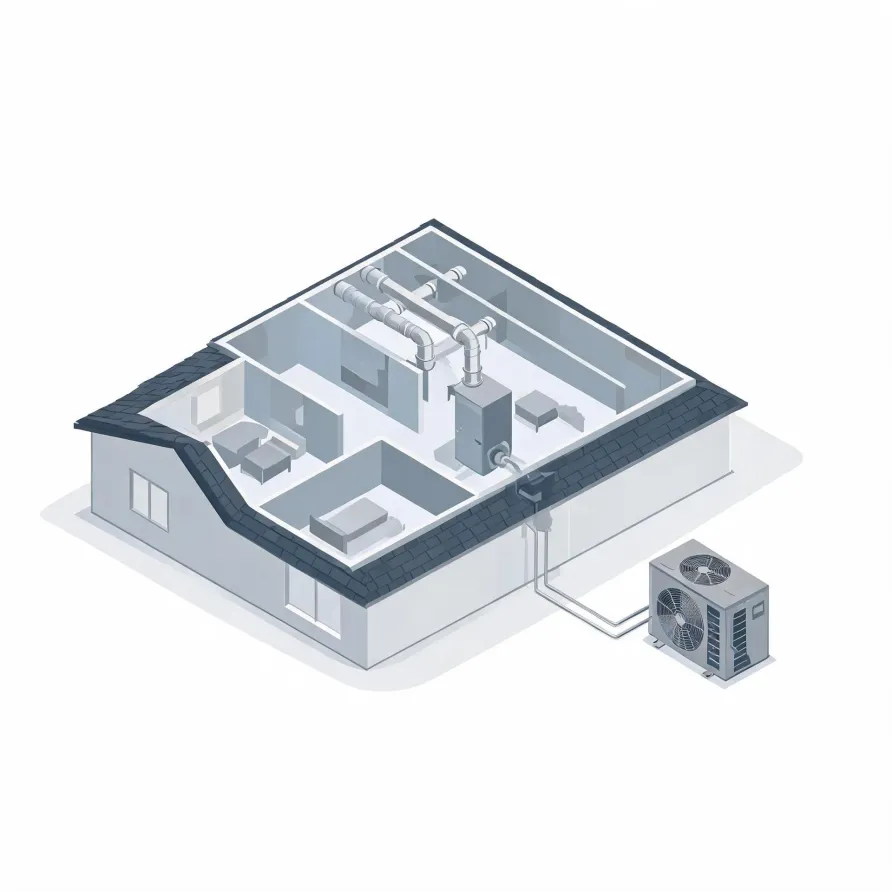
The outdoor unit sits outside the house and holds the compressor and the outdoor coil. These are common starting points when something goes wrong: a failed compressor means the system stops moving heat entirely, while a damaged or dirty coil affects how well the unit can do its job. The refrigerant lines running between the outdoor unit and the indoor air handler carry the substance that makes the whole exchange possible, and a leak in those lines is one of the first things a contractor will test for.
Inside the house, the air handler contains the indoor coil and the blower. The blower pushes conditioned air through the home, and when it fails or slows, airflow problems follow. The expansion valve, which sits in the refrigerant circuit, controls how refrigerant moves between the two coils, and a stuck or malfunctioning valve can mimic the symptoms of several other faults.
The drawing shows a general layout of these components, and a licensed contractor determines what applies to your specific system and house.
Get matched in Pulaski CountyPulaski County, by the numbers
77 severe weather events were recorded in Pulaski County, Virginia between 2015 and 2024.
NOAA National Centers for Environmental Information, Storm Events Database, bulk CSV export, events 2015-01-01 through 2024-12-31.Half the homes in Pulaski County, Virginia were built in 1975 or earlier (2020-2024 ACS 5-year).
U.S. Census Bureau, 2020-2024 American Community Survey 5-Year EstimatesPulaski County, Virginia holds 17,056 housing units (2020-2024 ACS 5-year).
U.S. Census Bureau, 2020-2024 American Community Survey 5-Year EstimatesOwners occupy 73.4% of the occupied homes in Pulaski County, Virginia (2020-2024 ACS 5-year).
U.S. Census Bureau, 2020-2024 American Community Survey 5-Year EstimatesCodes & Standards for Heat Pump Repair in Pulaski County, Virginia2 sourced rules & standards
Contractor Rules in Pulaski County, Virginia
Virginia’s contractor licence classes start above $1,000: the entry class covers a single contract or project over $1,000 but less than $30,000, or less than $250,000 of work in any 12-month period, with larger classes above that.
Virginia requires a contractor licence: no person may engage in, or offer to engage in, contracting work in the Commonwealth without one.
Severe Weather Events in Pulaski County, Virginia
Heat pumps in Pulaski County run against whatever the climate puts out, and weather extremes are what wear mechanical systems down fastest. The chart below records severe weather events logged in the county so local contractors can see what the equipment here has been working against.
77 severe weather events, 2015–2024. Source: NOAA National Centers for Environmental Information, Storm Events Database.