Tell us about the job
Takes about a minute. No obligation.
A heat pump in this county has been running against a weather record that puts real, repeated strain on its outdoor components. 130 severe weather events were recorded in Rappahannock County, Virginia between 2015 and 2024. At that rate, the refrigerant lines, contactors, and outdoor coil on a system here accumulate wear that a contractor has to account for before they can say whether a failed part gave out from age or from what the climate has put it through. Both answers produce different repairs and different parts on the truck.
Refrigerant lines corrode from the inside, contactors pit, and capacitors drift well before anything looks obviously wrong from outside the cabinet. Half the homes in Rappahannock County, Virginia were built in 1982 or earlier (2020-2024 ACS 5-year). That history of service cycles means a contractor opening a heat pump here finds compressor wear, valve condition, and coil state that the unit's exterior gave no sign of. Parts availability follows from what is actually inside, and some components in systems this well-aged are no longer in current production runs. The quote comes from what the opened equipment contains, not from the nameplate.
The Parts of a Heat Pump a Contractor Checks First
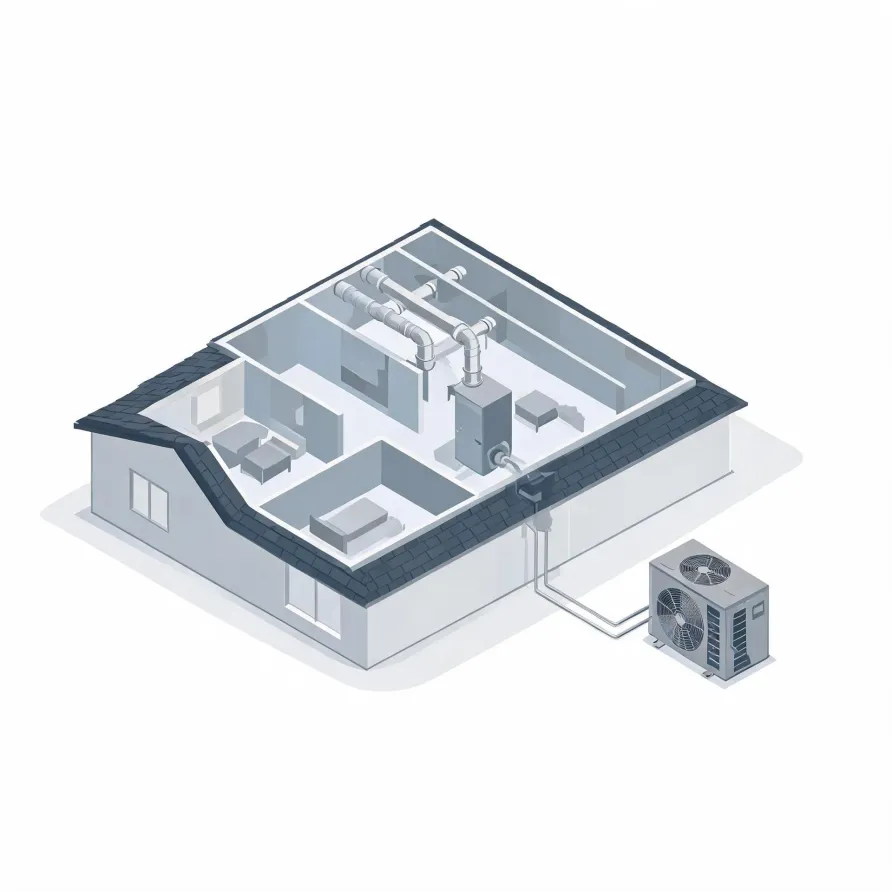
The outdoor unit sits on a pad beside the house and holds the compressor and the condenser coil. The compressor is where a contractor starts when a heat pump stops heating or cooling altogether. A failed compressor, a refrigerant leak at the coil, or a seized fan motor in that cabinet are the usual sources of a system that runs but does nothing useful.
Inside the house, the air handler holds the evaporator coil and the blower fan that moves conditioned air into the living space. The expansion valve, which sits between the two coils and controls refrigerant flow, is a smaller but common fault point when the system short-cycles or loses capacity. The refrigerant lines connecting the two units also get checked for leaks and proper pressure.
The drawing shows a typical heat pump layout, and a licensed contractor determines which components and conditions apply to your specific home.
Get matched in Rappahannock CountyRappahannock County, by the record
130 severe weather events were recorded in Rappahannock County, Virginia between 2015 and 2024.
NOAA National Centers for Environmental Information, Storm Events Database, bulk CSV export, events 2015-01-01 through 2024-12-31.Half the homes in Rappahannock County, Virginia were built in 1982 or earlier (2020-2024 ACS 5-year).
U.S. Census Bureau, 2020-2024 American Community Survey 5-Year EstimatesRappahannock County, Virginia holds 3,865 housing units (2020-2024 ACS 5-year).
U.S. Census Bureau, 2020-2024 American Community Survey 5-Year EstimatesOwners occupy 73.4% of the occupied homes in Rappahannock County, Virginia (2020-2024 ACS 5-year).
U.S. Census Bureau, 2020-2024 American Community Survey 5-Year EstimatesCodes & Standards Governing Heat Pump Repair in Rappahannock County, Virginia2 sourced rules and standards
Licensing Rules for HVAC Repair in Rappahannock County, Virginia
Virginia’s contractor licence classes start above $1,000: the entry class covers a single contract or project over $1,000 but less than $30,000, or less than $250,000 of work in any 12-month period, with larger classes above that.
Virginia requires a contractor licence: no person may engage in, or offer to engage in, contracting work in the Commonwealth without one.
Weather Stress on HVAC Equipment in Rappahannock County
Heat pumps work harder when the weather swings hard, and that load shows up over time as wear on the components a technician is most often asked to repair. How often conditions push equipment past its comfort range is a local fact, which is why the chart below tracks recorded severe weather events for this area.
130 severe weather events, 2015–2024. Source: NOAA National Centers for Environmental Information, Storm Events Database.